Notion has 30M+ users across 200+ countries and a $10B+ valuation — built without the paid-acquisition machine most SaaS companies run. It's easy to call that a content win, because Notion is everywhere on YouTube and in blog posts. But Notion didn't out-create its competitors. It out-distributed them — by making the product itself the channel and letting other people run it for free.
The near-death experience that changed everything
In 2015, Notion nearly died. Co-founders Ivan Zhao and Simon Last scrapped the codebase, moved to Kyoto, and rebuilt the product. It relaunched publicly in 2018, hit #1 on Product Hunt, and reached an estimated ~$2M ARR. The comeback wasn't a marketing budget — it was a product designed, from the rebuild on, to be shared.
The growth numbers nobody puts in one place
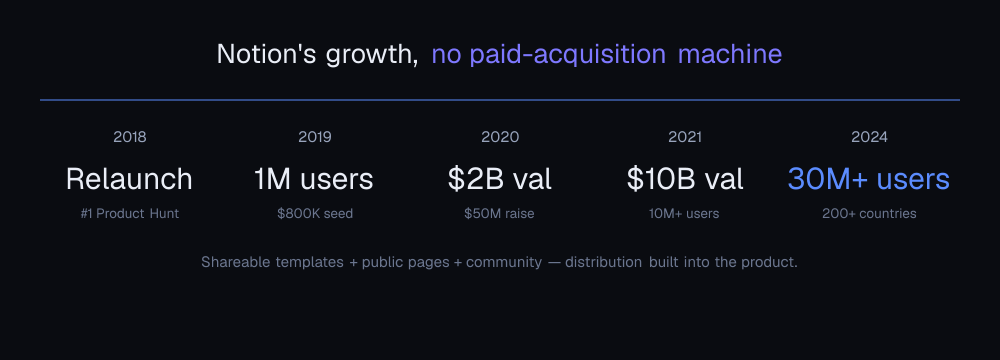
- 2018 — public relaunch, #1 on Product Hunt, ~$2M ARR (estimated)
- 2019 — crossed 1M users; raised an $800K seed
- 2020 — raised $50M at a $2B valuation; the pandemic became an inflection point
- 2021 — 10M+ users; raised $275M at a $10B valuation
- 2022 — ~$67M ARR (estimated)
- 2023 — ~$100M ARR (estimated); 10,000+ community templates
- 2024 — 30M+ users across 200+ countries; $10B+ valuation maintained
How the template ecosystem became a free sales force
Notion's template gallery isn't a feature — it's a distribution channel with a product attached. Users build templates, share them publicly, and by 2023 there were 10,000+ community templates. Each one is a free, highly specific, socially-proofed demo that pulls in new users. Most companies try to hire their way to content scale. Notion engineered the conditions so its users did the distributing.
The community flywheel: ambassadors, subreddits, and YouTube
Notion gave its most engaged users status and tools. The Ambassador Program offered early access, recognition, and direct relationships with the product team. The r/Notion subreddit grew past 300,000 members. Independent creators like Thomas Frank built entire YouTube channels on Notion tutorials. None of this was payroll — it was a community handed the means to distribute, and motivated to.
Notion's SEO engine: product pages as a channel
Because workspaces and pages are shareable by default, public Notion pages get indexed by search engines — turning the product's own output into a discovery surface. notion.so draws roughly 3 million monthly organic visitors. The product doesn't just hold content; it generates distribution.
Why user-generated content did more than any blog post
A template or tutorial made by a real user carries social proof, specificity, and authenticity at the same time. As Nielsen found, “92% of consumers trust peer recommendations over brand advertising.” A Notion user showing their actual system out-converts any brand-authored post — and Notion gets thousands of them for free.
The B2C-to-B2B crossover nobody planned
Freemium put creation tools in millions of individual hands. Those individuals brought Notion into their companies — a bottom-up path from personal use to team and enterprise adoption that no one designed on a whiteboard. The distribution layer (free, shareable, individual) became the sales pipeline (teams, companies) without a traditional outbound motion.
What didn't work — and what Notion got lucky with
This isn't a clean playbook to copy blindly. Notion spent years near death, leaned on timing (the 2020 shift to remote work), and benefited from a crossover it didn't plan. The transferable part is the mechanism, not the luck.
Lessons for builders
- Build sharing into the product, not onto it.
- Create the conditions for distribution, not just content.
- Your early adopters are your distribution network — choose them intentionally.
- Make your product's output shareable, not just the product itself.
- Treat freemium as distribution infrastructure, not just a conversion funnel.
- Your founder voice sets the early-adopter profile — it's a targeting mechanism.
The Runnax read
Notion proves the thesis Runnax is built on: most builders don't have a product problem — they have a distribution problem.Notion didn't win on content volume or on being the best editor; it won by engineering distribution into the product so it compounded for free. Knowing that isn't the hard part — building and running the system is, while you also have a product to ship. That's the gap Runnax closes: it diagnoses why customers aren't finding you, finds what works in your space (with real examples like this one), builds the deterministic distribution system, and runs it.
Sources: Notion; TechCrunch; The Verge; Ahrefs; Nielsen; Wired. ARR figures marked “estimated” are external estimates; figures are reported from these sources and not independently verified by Runnax.